
Call chain analysis
Last Updated:2025-11-14
Function overview
Call chain analysis enables cross-application, multi-dimensional call chain query and analysis. By combining application names, API names, response times, and other filters, users can identify chains with specific exceptions. This feature allows users to focus on key chains within extensive data, quickly identify abnormal chains, and troubleshoot issues effectively.
Traced call chain list
- Log in to the Baidu AI Cloud console.
- In the left navigation menu, click on "Application Performance Monitor" and then "Call Chain Analysis," and choose the target region at the top.
- Specify query criteria in the search dropdown and define the desired time range using the time selector in the top right corner.
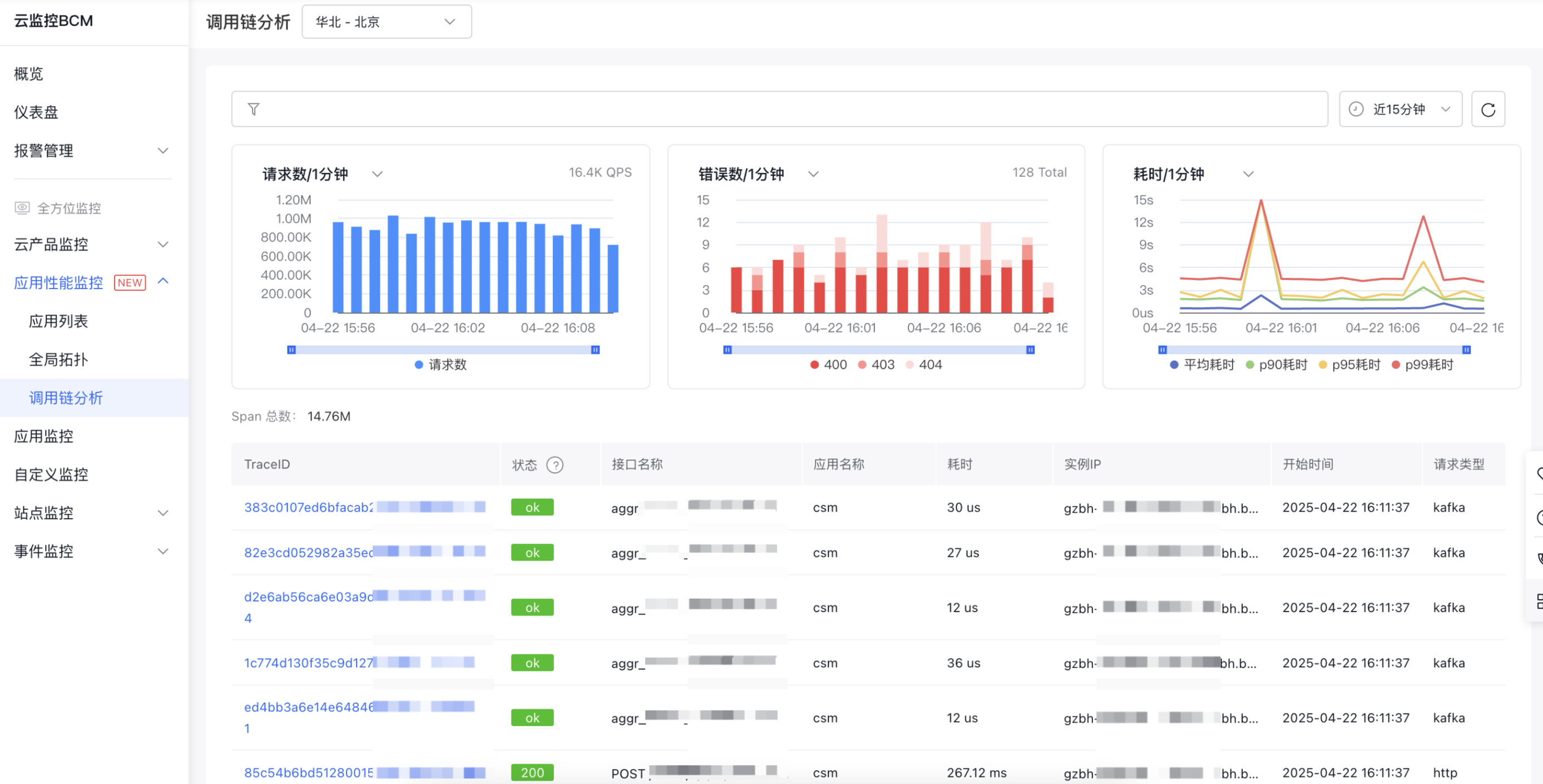
| Filter fields | Description |
|---|---|
| Application name | Only single selection is supported. |
| Instance | Only single selection is supported. |
| API | The API name called by an application, which can be manually entered, supports only a single query at a time. |
| Response time | Call chain latency can also be manually entered. For instance, "200-300" filters for call chains with response times between 200ms and 300ms. |
| Request type | Only single selection is supported. Supported request types include HTTP, gRPC, Redis, and MySQL. |
| Status | Indicate whether the call was successfully executed. |
| TraceID | It can be manually entered, with support for only single value queries at a time. |
| Advanced query | Supports querying additional call attributes. When inputting query conditions, use a prefix of "attributes." For example, entering "attributes.http.response.status_code" in the query condition field with a value of "400" will filter calls with a 400 status code. |
Traced call chain details
- Log in to the Baidu AI Cloud console.
- In the left navigation menu, click on "Application Performance Monitor" and then "Call Chain Analysis," and choose the target region at the top.
- Specify query criteria in the search dropdown and define the desired time range using the time selector in the top right corner.
- Each row in the query results represents a span. Click the corresponding TraceID to open the "Chain Details" page.
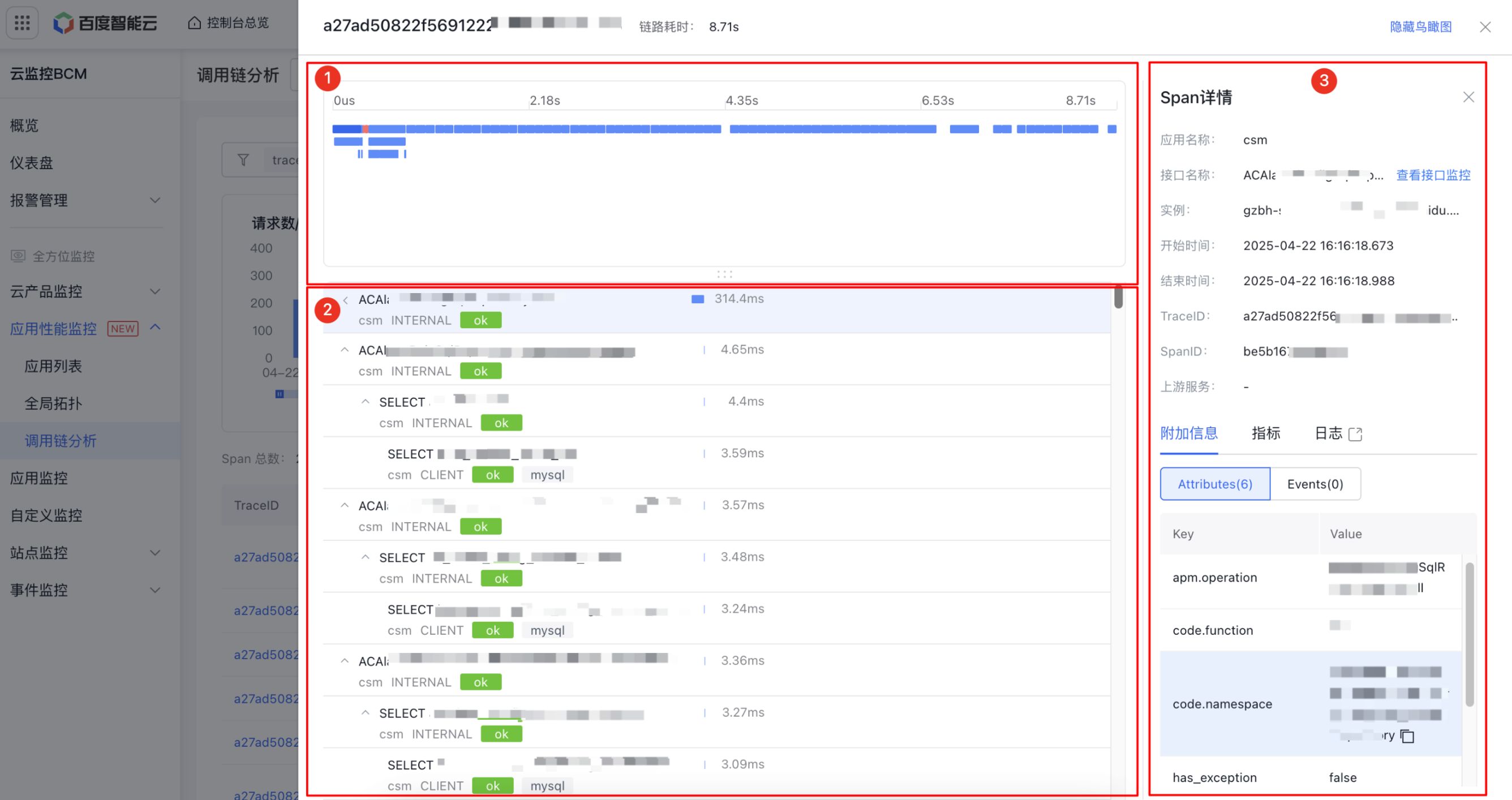
Capability description
Module 1
- The aerial view shows the latency distribution of spans in the entire call chain. In the top right corner of the page, you can switch between "Hide" and "View" for the aerial view.
- Applications are displayed using different colors, with calls that have exceptions marked in red.
- The timeline visualizes the entire duration of the trace data.
Module 2
- Each row in this section represents span data and illustrates the hierarchical relationship between parent and child spans.
Module 3
- Additional details: Includes both span attributes and events.
- Metrics: Displays metrics related to the span, such as request count, error count, latency, and more.
- Logs: If your application is linked to a log service, click to quickly navigate to the
page in the application details to view service logs corresponding to the current TraceId. - Exception: If a span records exception information, this page will show the specific details of the exception.